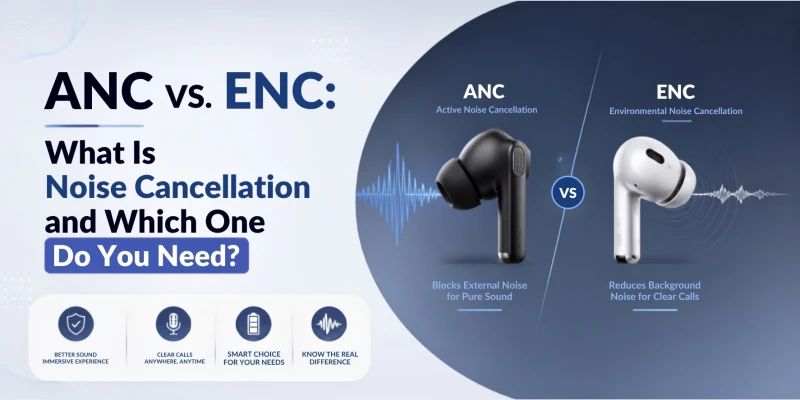
If you wanted to buy earbuds in the last two years, you probably ran into two acronyms on the same product page: ANC and ENC. Even if they sound similar, they are not the same thing, and mixing them up is the reason you end up buying the earbuds for the wrong problem. One technology decides what you hear. The other decides what the person on the other end of your call hears. Understand that distinction, and the rest of the buying decision gets a lot simpler.
This guide breaks down what ANC and ENC actually do, how the physics behind each one works, and which one fits your situation, whether that is a lecture hall, a Zoom meeting from home, or a bus ride down the Dhaka-Chattogram highway.
What Is ANC?
ANC stands for Active Noise Cancellation. It is a listening-side technology built into the earbud or headphone itself, and its job is to reduce the outside noise that reaches your eardrum.
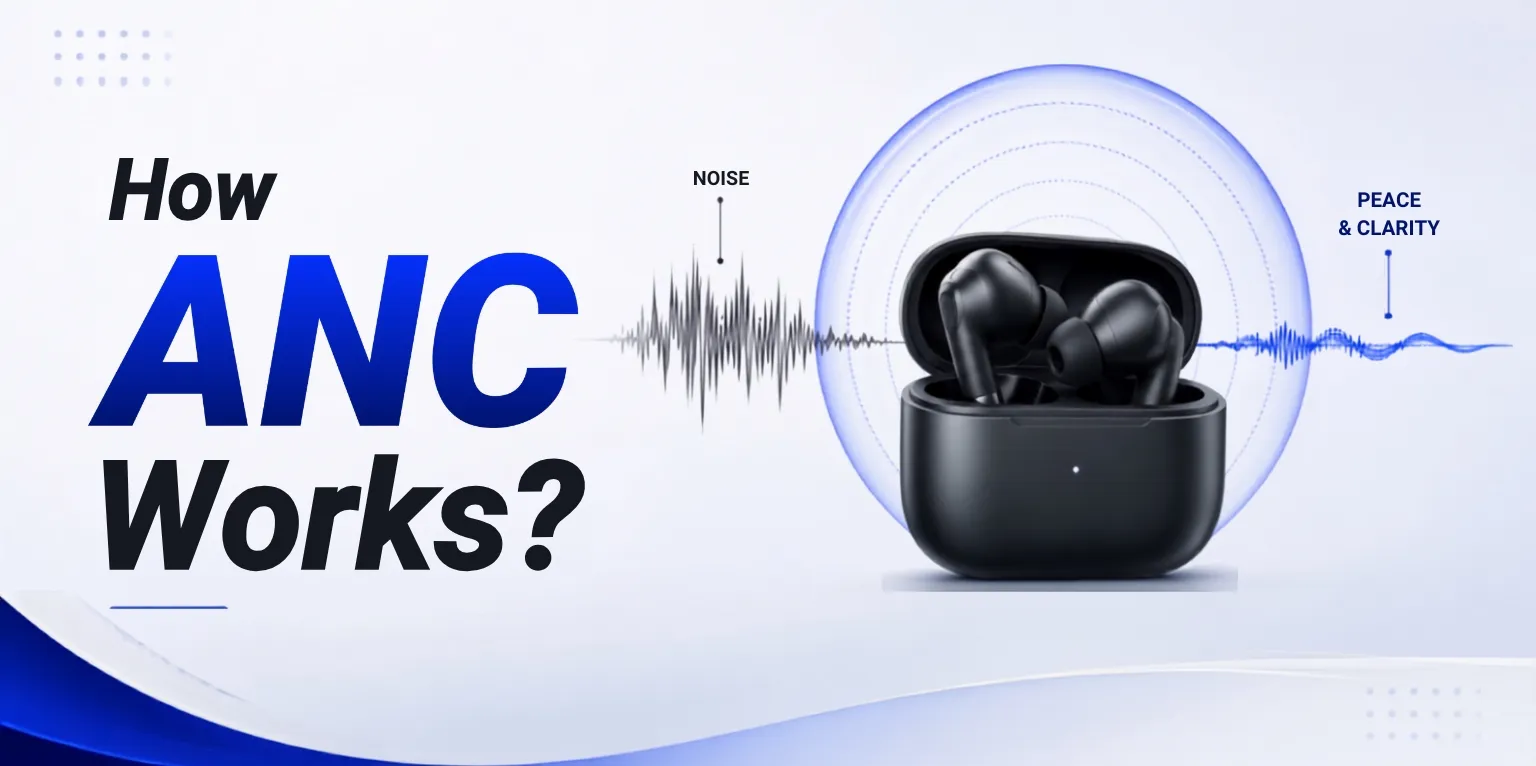
ANC earbuds use tiny built-in microphones to detect the noise around you, like an air conditioner's hum, an airplane engine, traffic etc and generate a sound wave which is the opposite of that noise. When the two waves meet, they cancel each other out before the sound reaches your ear. You end up hearing less of the unwanted noise and more of whatever you choose to listen to.
What Is ENC?
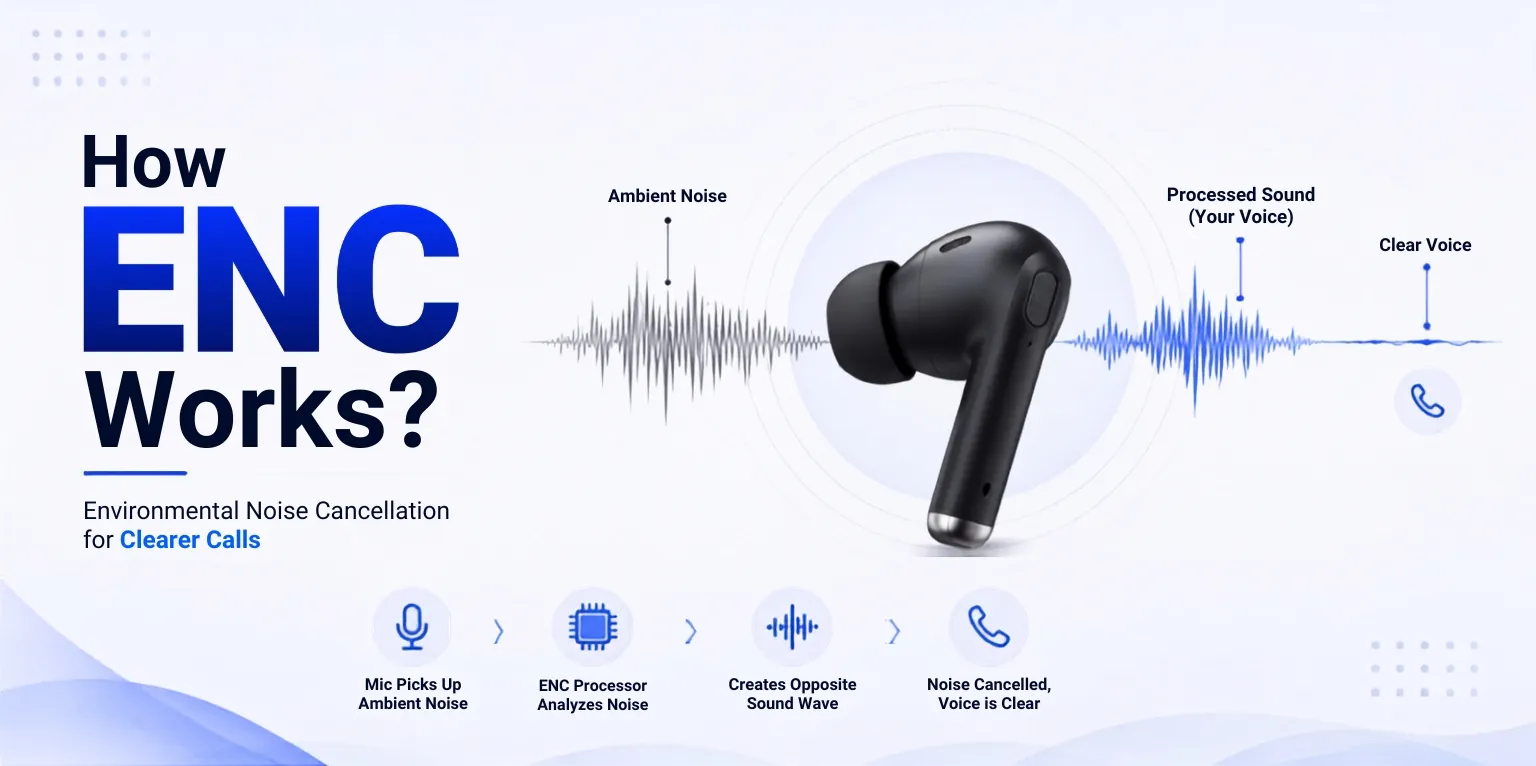
ENC stands for Environmental Noise Cancellation. Unlike ANC, it does not affect what you hear at all. It works entirely on the microphone side, clearing your voice before it gets sent to the person you are in a call with.
When you take a call on a busy street or in a crowded office, ENC uses two or more microphones to tell the difference between your voice and everything else like traffic, wind, other conversations, a fan running nearby etc. The embedded software removes the noise and sends a clearer version of your voice. The person you are talking to hears you properly and not your surroundings.
ANC vs ENC: Key Differences
The short version: ANC is for your ears, ENC is for your mouth.
| ANC | ENC |
What it controls | What you hear | What the caller hears |
Works during | Music, podcasts, general listening, any time the earbuds are on | Phone calls, voice notes, video meetings |
Hardware | Outward and/or inward-facing mics, plus a speaker driver | Two or more mics, usually with one tuned towards your mouth |
Goal | Reduce ambient noise reaching your eardrum | Remove background noise from your outgoing voice |
Battery impact | Noticeable, often cuts playtime by 15 to 30 percent | Minimal, since it only runs during calls |
Affects sound quality | Can slightly change audio in cheaper versions | Doesn't affect music playback at all |
How ANC Works
The physics behind ANC is quite interesting. ANC relies on the principle of superposition: when two sound waves of equal amplitude and frequency meet but are 180 degrees out of phase, they cancel each other out through destructive interference. A microphone on the earbud picks up the incoming noise, a processor flips that waveform, and a speaker plays the inverted version a few milliseconds later. If the timing and amplitude are matched closely enough, the two waves sum to near zero at your eardrum.
There are three types of ANC technology:
Feedforward ANC places the microphone outside of the earbud, facing the environment. It picks up noise before it reaches your ears, which gives the processor more time to analyse and produce the anti-noise signal. The drawback is that it cannot account for how the noise changes once it passes through your ear canal.
Feedback ANC places the microphone inside the earbud, closer to your eardrums. It measures the actual sound present in your ear, including whatever leaked past the seal. This makes it more accurate to your listening experience, but also more prone to feedback loop instability if not tuned carefully.
Hybrid ANC combines both but are more costly. Most ANC earbuds above the budget tier utilizes hybrid ANC as it covers the weaknesses of each method.
How ENC Works
ENC does not try to "cancel" sound the way ANC does. It is kind of like audio forensics: separating your voice from everything else using multiple microphones and signal processing.
A typical ENC setup uses two to four microphones per earbud. One is positioned to primarily capture your voice (closer to your mouth, often using bone conduction), while the others capture the ambient environment. The device compares the signals: anything present in the "environment" mics but absent from the "voice" mic is marked as noise and is suppressed or removed before the call audio is transmitted.
Modern versions of ENC also include AI noise suppression. Instead of relying completely on fixed signal-processing methods, a trained model recognises the audio pattern of human speech and distinguishes it from other sounds like wind, engine noise, or crowd chatter, etc. This is what brands market as "AI ENC," and it is the reason call quality on recent mid-range earbuds has improved noticeably compared to models from just a few years ago.
ANC vs ENC for Different Use Cases
Students
If you study in a busy household, a shared hostel room, or anywhere with constant background chatter, ANC is a necessary feature for concentration. It quiets the room while you read, watch lecture recordings, or work through problem sets. Most people are able to study better at a lower, safer volume as they are not distracted by background noise.
ENC matters more during online classes. If you are expected to speak up, answer questions, or join a discussion section, a teacher or classmate hearing rickshaw horns and ceiling fan noise over your voice is a real problem.
Some budget earbuds in the 1,500 to 3,000 taka range include both, so students do not necessarily need to pick one over the other anymore. However, they will not perform as well as you’d expect compared to the expensive ones.
Office Users
For meetings, ENC is the priority. Most professional calls happen with the listening side largely unaffected by the environment (you are usually somewhere reasonably calm), but the speaking side is where things are hectic. A colleague typing loudly, an open-plan office, traffic outside a home office window, etc., result in your speech being muffled. ENC is what keeps you from being "that person" whose mic picks up everything.
ANC becomes valuable for deep work, blocking out office chatter so you can focus on writing, coding, or analysis without noise-cancelling headphones turning into a social statement that you do not want to be disturbed. For people working from home, both matter for different parts of the day: ANC while writing reports, ENC while presenting them on a call.
Travelers
This is where ANC earns its reputation. Airplane cabin noise sits mostly in the low-frequency range, exactly where ANC performs best. That is why the marketing focuses on flight comfort. A long flight with good ANC changes how tired you feel on arrival, since constant low-frequency noise exposure is fatiguing even when you are not consciously registering it.
Bus travel in Bangladesh poses a similar situation: engine noise, road rumble, and the occasional horn. ANC helps here too, though buses introduce more unpredictable mid and high-frequency noise (conductors calling stops, other passengers, traffic) that ANC handles less cleanly than a plane's steady noise.
For daily commuting, whether by rickshaw, CNG, bus, or on foot through Dhaka traffic, ANC is useful but worth pairing with awareness. Total noise isolation while crossing a street is very risky. Earbuds with a quick-access transparency mode are useful here since you can toggle ANC off without removing the earbuds when you need to hear horns or someone calling out to you.
Gamers
ANC and ENC are both important in gaming. ANC helps with immersion in single-player or story-driven games by blocking out room noise, but many competitive gamers deliberately avoid full ANC because it removes useful situational audio cues from their actual room and also might cause latency issues. That latency question comes up often: Does ANC affect gaming latency? The honest answer is that ANC processing itself, the noise-cancellation circuit, runs largely independent of the Bluetooth audio codec and does not meaningfully add to input lag in well-designed earbuds. The latency gamers actually notice almost always comes from the Bluetooth codec and connection mode, not from ANC. If you are buying for competitive, fast-paced games, prioritise a low-latency gaming mode over worrying about ANC specifically.
ENC matters more directly for gaming if you play in squads and need teammates to hear your callouts clearly over keyboard noise, a fan, or a noisy household. A good multi-mic ENC setup does for your gaming comms what it does for any other call.
Content Creators
ENC is the relevant technology here, not ANC, since ANC has zero effect on what your microphone picks up. If you are recording voiceovers, podcasts, or social content using earbuds as a quick mic, ENC quality directly determines how clean that audio sounds.
But to be honest, dedicated earbuds are rarely the best choice for serious voice recording. ENC is built for live calls, where some processing artifacts are an acceptable tradeoff for clarity in real time. For pre-recorded content where you can edit afterward, a basic external microphone with proper room treatment will almost always sound better than even excellent ENC. Use ENC earbuds for quick voice notes and on-the-go recording, and step up to a real microphone for anything you plan to publish.
Is ANC Worth Buying?
For most people in a noisy country like Bangladesh, yes, with some caveats worth knowing before you buy.
On the performance side, ANC ratings on spec sheets (28dB, 35dB, 42dB, sometimes higher) describe the maximum noise reduction under ideal lab conditions, not real-world performance. Depending on fit, ear shape, and the type of noise, it is usually several decibels lower . A decibel scale is logarithmic, so a 35dB rating is not just vaguely "good," it represents reducing sound intensity by more than a thousand-fold at the test frequency. In practice, anything in the 30 to 40dB claimed range from a properly fitted earbud will noticeably quiet a bus ride or office. Above 45dB, the real-world difference is very little, and fit quality starts to matter more than the chip generation
ANC does drain more battery than earbuds without it, commonly 15 to 30 per cent less playtime with ANC switched on, since the mics and processor are running continuously rather than only during calls. It can also have a mild effect on audio quality in cheaper versions.
ANC is worth buying if you regularly deal with constant background noise in daily commutes, shared living spaces, open offices, frequent flights, etc. It is less essential if your main listening environment is already quiet, in which case that budget is better spent on driver quality or battery life.
Is ENC Enough for Calls?
For the vast majority of everyday calling, yes. ENC alone handles typical street noise, household chatter, and office hum well enough that the other party will hear you clearly in most situations.
It has limits, though, and they explain a common complaint: "why does my voice sound robotic on calls?" Aggressive noise suppression algorithms, particularly older or cheaper ones, sometimes shave off parts of your natural voice along with the noise, especially in very loud, chaotic environments where the algorithm struggles to cleanly separate speech from background sound. This produces that thin, slightly synthetic quality people describe as robotic. It is usually a software tuning issue rather than a hardware defect, and it tends to be worse on budget earbuds using older ENC chips than on recent mid-range and premium models with AI-based suppression.
ENC is not designed to remove every kind of surrounding noise equally. It is tuned for human speech detection, so it handles voices, wind, and steady ambient noise reasonably well, but sudden, sharp sounds (a car horn, a door slamming) can still slip through and be heard by the caller, since the algorithm needs a brief window to recognise and react to new noise sources.
Common Problems With ANC and ENC (And How to Fix Them)
Why can't I hear people clearly during calls? This is usually a speaker or fit issue rather than an ANC or ENC problem, since neither technology processes incoming caller audio. Check your earbud tip size first. A poor seal lets in noise and weakens bass and clarity together. Then check call volume settings separately from media volume, as many phones manage these independently.
Why is my microphone picking up background noise despite ENC? Confirm ENC is actually enabled in your earbuds' companion app, since some models ship with it off by default or are only active in a specific call mode. Wind is the most common ENC failure case, since strong wind directly hits the microphone port and can overwhelm the algorithm's ability to distinguish it from speech; cupping the mic side with your hand briefly often confirms this is the cause.
Why does ANC not work properly, or why is there still noise with ANC on? The most frequent cause by far is an incorrect ear tip seal. ANC works assuming a baseline of passive isolation from a comfortable fit and layers active cancellation on top of it; without that seal, low-frequency noise leaks in around the cancellation entirely. Try a different tip size before assuming the hardware is faulty. Firmware can also matter, since manufacturers regularly release ANC tuning updates through their companion apps.
Does ENC remove surrounding noise for me, the wearer? No, and this is the single most common misunderstanding about ENC. It only affects what the other person hears on your call. If you want quieter surroundings for yourself, that is ANC's job, not ENC's.
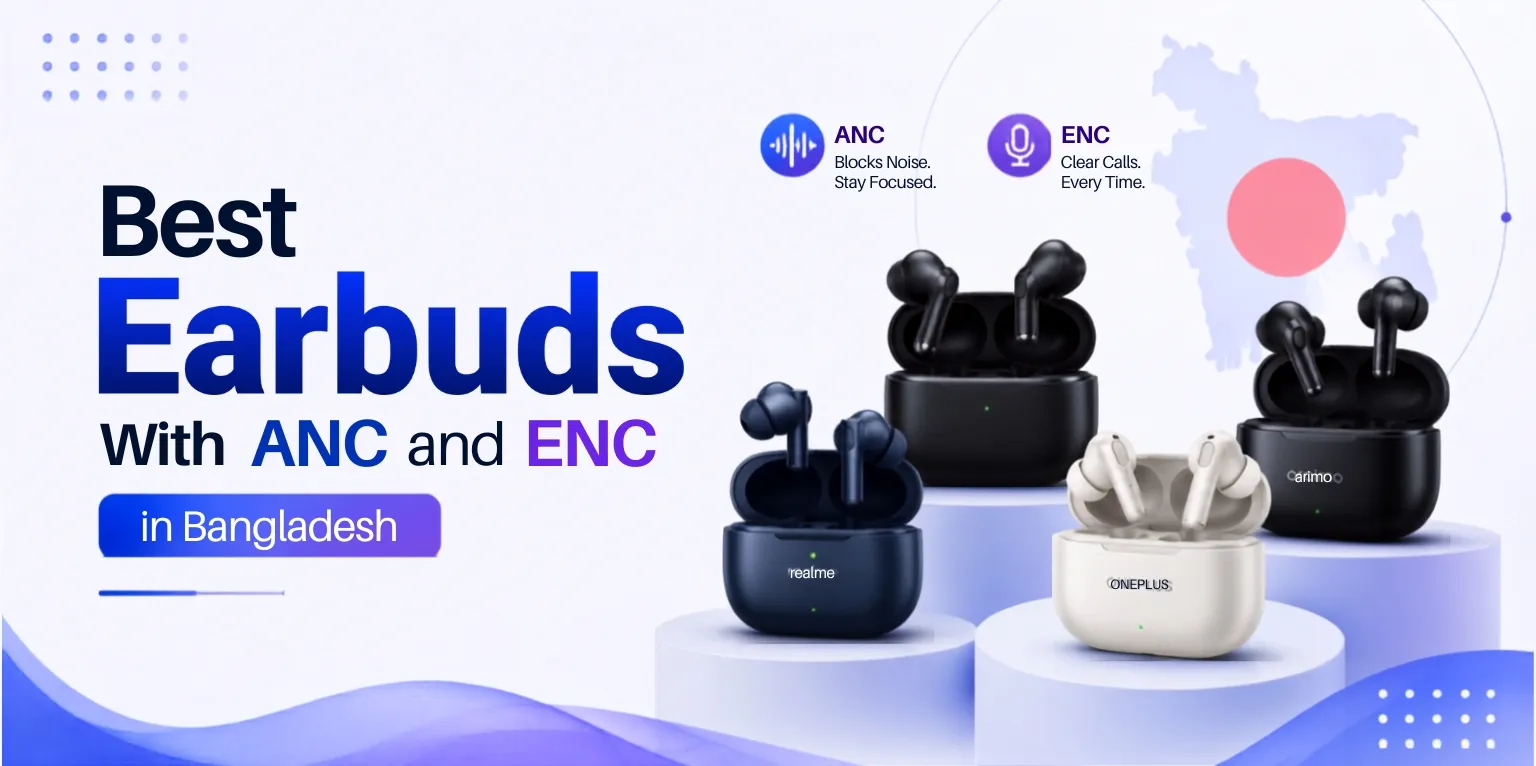
Best Earbuds With ANC and ENC in Bangladesh
The Bangladesh TWS earbuds market has expanded fast over the past two years, and features that used to be premium-only, basic ANC, and multi-mic ENC now show up at budget price points. Here is roughly how the market breaks down by price tier as of mid-2026.
Price range (BDT) | What you typically get | Good for |
Under 1,500 | Basic Bluetooth earbuds, no ANC, single-mic calling | Casual listening, first-time buyers |
1,500 to 3,000 | Entry ANC (often 25 to 35dB claimed) and basic dual-mic ENC start appearing | Students, budget commuters |
3,000 to 5,000 | More consistent hybrid ANC, 4-mic ENC setups, app-based EQ and ANC level control | Office workers, frequent callers |
5,000 and above | Adaptive or hybrid ANC up to 45 to 50dB claimed, AI ENC, premium drivers, multipoint connection | Frequent flyers, audiophiles, professionals on calls all day |
Brands with consistent ANC or ENC presence in the Bangladesh market include Haylou, Xiaomi (Redmi Buds), Oraimo, OnePlus, Anker Soundcore, Edifier, QCY, JBL, boAt, and Hoco, alongside Apple AirPods and Samsung Galaxy Buds at the premium end. Authorized retailers like SMS Gadget, Star Tech, Ryans, Pickaboo, Motion View, and Daraz are the usual places to buy in Bangladesh. Sticking to authorized sellers matters more for ANC and ENC earbuds specifically, since counterfeit units almost always cut corners on the microphone array and DSP chip first, which is exactly the hardware these two features depend on.
If you are specifically hunting under a 2,000 or 3,000 taka ceiling, expect to choose between stronger claimed ANC numbers or a better multi-mic ENC setup rather than getting top-tier performance in both, since hitting both well is what separates the 3,000 to 5,000 taka tier from the budget tier.
SMS Gadget offers the best deals on ANC and ENC earbuds from top-tier brands in Bangladesh across multiple price ranges. If you are looking to buy top-quality earbuds, visit SMS Gadget and choose from our vast collection. Frequently Asked Questions
1. Can ANC work during phone calls?
Yes, ANC keeps running during calls if it is switched on, since it operates independently of the call itself. It just won't do anything to clean up your voice for the other person; that part is ENC's job
2. Can ENC block the surrounding noise for me as the listener?
No. ENC only processes outgoing audio, the voice the other person hears. It has no effect on what reaches your own ears
3. Is ANC safe for the ears?
Yes, ANC itself is safe and does not damage hearing. If anything, it tends to protect hearing indirectly, since people no longer need to push volume up to compete with background noise. A small number of users report mild ear pressure or discomfort from certain ANC implementations, similar to cabin pressure on a flight, which usually fades with a few minutes of use or resolves with a different ear tip.
4. Does ANC completely remove noise?
No. Even high-end ANC reduces noise rather than eliminating it, and it is far more effective against steady, low-frequency sound than sudden or high-pitched noise. Combine it with a good physical seal (passive isolation) for the best practical result.
5. Does ENC improve microphone quality overall, or just during calls?
ENC's processing is generally active only during calls and voice-recording modes, not for general microphone use. It improves perceived clarity for the listener on the other end by suppressing background noise, though it does not improve raw microphone fidelity the way a dedicated recording mic would.
6. Which is better for meetings, ANC or ENC?
ENC matters more directly, since meetings live or die on whether others can hear you clearly. ANC is nice to have for blocking distractions while you listen, but it has no effect on how you sound to others.
7. Which is better for travel, ANC or ENC?
ANC, especially for flights, where the dominant engine and cabin noise sit in exactly the low-frequency range ANC handles best. ENC remains useful if you are taking calls during travel breaks or from a noisy station or terminal.
8. Is Hybrid ANC better than standard (feedforward-only) ANC?
Generally yes. Hybrid ANC combines feedforward and feedback microphones, which gives more consistent cancellation across a wider range of fits and noise types than either method alone.
9. Do all earbuds have ENC?
No. Many budget earbuds, particularly under roughly 1,500 taka, still ship with single-microphone calling and no real ENC processing. Check the spec sheet specifically, since "noise reduction" is sometimes used loosely in marketing without meaning true multi-mic ENC.
10. Can you have ANC and ENC together?
Yes, and most mid-range and premium earbuds today include both, since they address completely separate problems. ANC handles what you hear, ENC handles what your caller hears, and there is no technical conflict in running both at once.